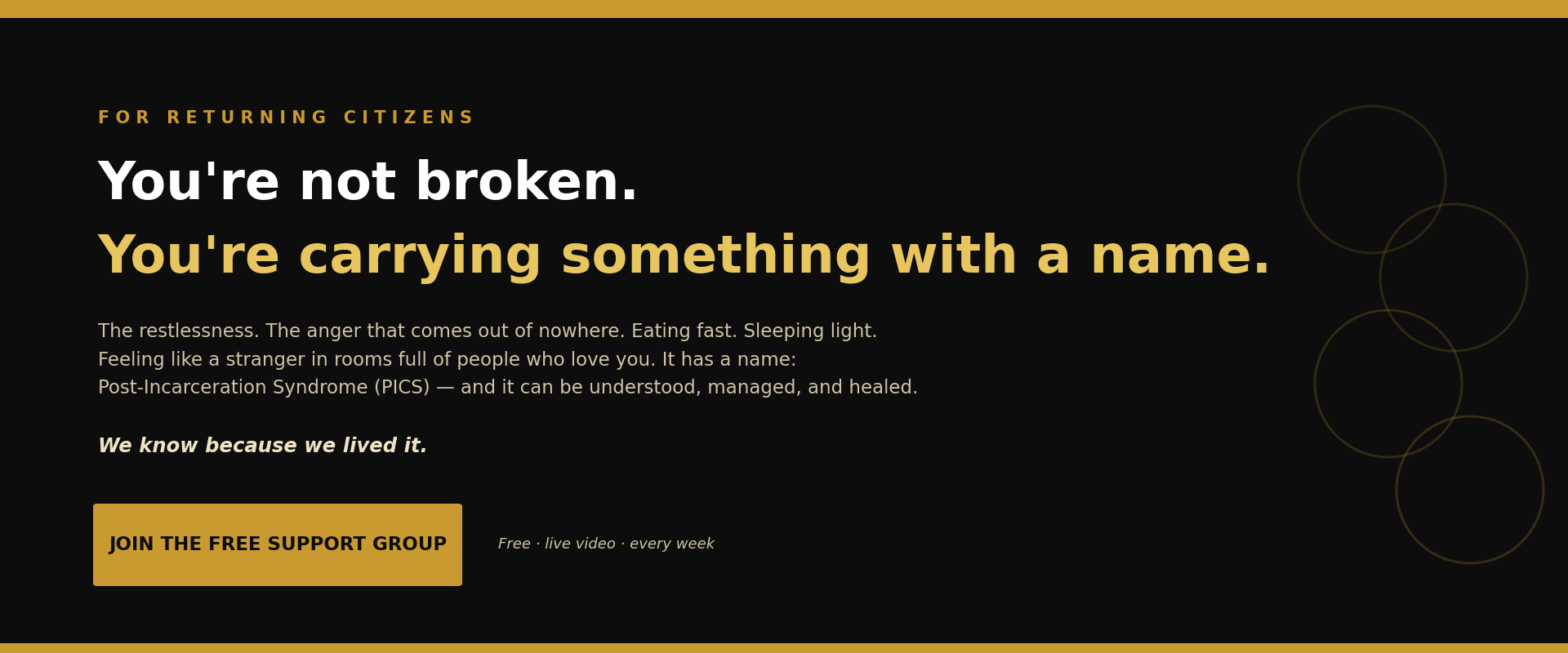
You're not broken. You're carrying something with a name. Post-Incarceration Syndrome can be understood, managed, and healed. Join the free support group.

Download the Breaking Chains Mending Minds App Today

Do you recognize this?

Tap any card. No one is keeping score.

The rules of inside are still running you You wait for permission. You keep your back to the wall. TAP TO READ MORE ▾
Choices feel dangerous. Schedules feel safer than freedom. That’s not weakness — it’s what years of living under total control teaches a mind. Institutionalized Personality Traits
Your alarm system won’t shut off Nightmares. Flashbacks. Jumping at sounds. TAP TO READ MORE ▾
Always scanning, never resting. Your body is still protecting you from a place you already left. Post-Traumatic Stress
The armor won’t come off Trust feels stupid. Distance feels safe. TAP TO READ MORE ▾
People say you’re cold. The truth: the armor that kept you alive inside doesn’t know the war is over. Antisocial Personality Traits
The pull is back — or never left Using to quiet what’s loud inside. TAP TO READ MORE ▾
Relapse after release isn’t a willpower story. It’s untreated pain looking for the only relief it’s ever known. Substance Use Disorders
The world is too much Crowds, choices, noise, open space — all overwhelming. TAP TO READ MORE ▾
After years of sameness and confinement, an ordinary grocery store can feel like an assault. Your senses are relearning the world. Social Sensory Deprivation

If any of this sounds like your life, you’re not weak and you’re not alone. This is what incarceration does to a mind. And there’s a way through.

UNDERSTANDING

POST- INCARCERATION SYNDROME

(PICS)

REAL PEOPLE.

REAL CHALLENGES.

REAL HEALING.

REAL CHANGE.

What is Post-Incarceration Syndrome (PICS)?

Post-incarceration syndrome (PICS) is a psychiatric disorder that affects individuals who have been incarcerated and then are released back into society. It is characterized by a range of psychological, emotional, and social difficulties that can arise as a result of being imprisoned. These difficulties can include depression, anxiety, post-traumatic stress disorder (PTSD), difficulty adjusting to life outside of prison, and difficulty forming and maintaining relationships.

— NATIONAL INCARCERATION ASSOCIATION

AWARENESS. UNDERSTANDING. REINTEGRATION. HOPE.

The Five Syndromes of Post-Incarceration Syndrome (PICS) A five-part wheel showing the BCMM curriculum framework: Institutionalized Personality Traits, Post-Traumatic Stress Disorder, Antisocial Personality Traits, Substance Use Disorders, and Social Sensory Deprivation. Institutionalized Personality Traits Post-Traumatic Stress Disorder Antisocial Personality Traits Substance Use Disorders Social Sensory Deprivation PICS The Five Syndromes of Post-Incarceration Syndrome BCMM™ Curriculum Framework
BREAKING CHAINS  MENDING MINDS The five syndromes of PICS: institutionalized personality traits, post-traumatic stress disorder, antisocial personality traits, substance use disorders, and social sensory deprivation.
START HERE — IT’S FREE

Free Weekly Support Group

Live video · every week · no cost, ever

Facilitated by our co-founder Akili — 25 years of lived experience, trained peer support specialist. No forms, no fees, no judgment. Family welcome.

JOIN THIS WEEK’S GROUP
$35 · SELF-GUIDED

Recovery Workbook + App

Work at your own pace

The PICS Workbook walks you through each of the five syndromes with real exercises, not lectures. Comes with our mobile app.

FREE TO YOU — AGENCY-FUNDED

6-Week PICS Workshops

Our deepest work — with people walking the same road

Includes the PICS Workbook, free online CRP certificate, lunch, and a graduation your family can attend. Paid for by agencies, grants, and sponsors — not by you. Ask your case manager or parole agent, or tell us who to talk to.

FAQs

Frequently asked questions

Is PICS a real diagnosis?
It’s not yet in the DSM (the manual doctors use), but researchers describe it as a distinct form of post-traumatic stress, communities use the term every day, and Congress has asked the National Institute of Mental Health to study it. What matters right now: the struggles are real, and they respond to support.
Does it go away?
It gets better — with understanding, tools, and people. Some symptoms fade, some you learn to manage. What doesn’t work is pretending it isn’t there.
What does the support group cost?
Nothing. Ever.
Can my family come?
Yes. And there’s a whole workshop just for them. For Families →
Is this therapy?
No — it’s education and peer support. If you need clinical care, we’ll help you find it, and what you learn here works alongside it.
Join the free weekly support group — live video chat, every week, no cost